
That gap between feeling something and being able to name it is common, and it says nothing bad about you. It's also one of the most frequent reasons people go looking for Internal Family Systems (IFS) therapy. The question of who IFS therapy is for and who it may not suit is especially relevant when deciding whether this approach is the right fit. For many people who struggle to understand their emotions, IFS fits well, as long as they're steady enough to slow down and look inward. For some, it's the wrong place to start right now.
TL;DR Quick Answers
Who Is IFS Therapy For? (And Who It May Not Suit)
IFS therapy is for people who feel a lot but struggle to name, sort or change it, and who are stable enough to slow down and look inward. The common thread is a gap between knowing your patterns and being able to shift them.
Often a good fit if you:
Feel strong or conflicting emotions but draw a blank when asked to name them
Would rather notice body sensations and images than talk things through
Live with a harsh inner critic
Understand your patterns, yet insight alone hasn't changed them
Have done talk therapy and stalled
May not suit you (or not yet) if you:
Are in crisis or unsure of your safety, so call or text 988 first
Are experiencing psychosis or severe dissociation
Are in active substance use that needs stabilizing
Want structured skills and homework, where CBT or DBT may fit better
Bottom line: Fit and timing matter more than any label. A short consultation with a licensed, IFS-trained therapist is the fastest way to find out.
Top Takeaways
IFS therapy often suits people who feel strongly but have trouble naming or sorting their emotions.
IFS treats "I don't know what I feel" as a protective part at work, not a personal failing.
People in crisis, people with psychosis or severe dissociation, and anyone who needs structured skills first may do better starting elsewhere.
IFS research looks promising but early, with the strongest pilot results so far in depression and PTSD.
A long medical recovery carries emotional weight, and therapy can help alongside medical care, never in place of it.
When Feelings Are Hard to Name
Struggling to understand your emotions usually means your body sends a signal your mind can't decode. You might notice tight shoulders, a restless urge to get up and move, or a heaviness that settles in around dinner, and still have no idea what any of it means. Researchers call the stronger version of this alexithymia. It sits on a spectrum, so there's no need to diagnose yourself with it. Population studies in Germany and Finland found roughly 10 to 13% of adults scoring above the cutoff.
Day to day, it can look like:
Feeling "bad" without knowing whether it's sadness, fear or anger
A clenched jaw or racing heart that arrives before any thought does
Going quiet when things get emotional, then wondering afterward why you shut down
Drawing a blank when someone asks how something made you feel
None of that means you're broken. More often, some part of you learned early that feelings were safer at a distance, and it was probably right at the time.
The Emotional Side of a Long Recovery
Healing a serious wound can mean weeks or months of dressing changes, broken sleep, pain, and leaning on other people for things you used to handle alone. Your body looks different and your routine disappears. Fear and grief pile up quietly. Plenty of patients cope with the only way that feels manageable, which is to stop checking in with themselves altogether.
That matters for more than mood. Researchers behind the Hisayama Study, a population study in Japan, found that adults with higher alexithymia scores had a greater risk of chronic pain. They couldn't say which one drives the other. Still, the overlap is hard to ignore if you've read about why wound vac therapy can be painful or what it takes when you're managing slow-healing wounds.
Your care team handles the wound itself, and therapy won't change that. What therapy can do is lighten the emotional load while your body does its part.
How IFS Therapy Works With Feelings You Can't Name Yet
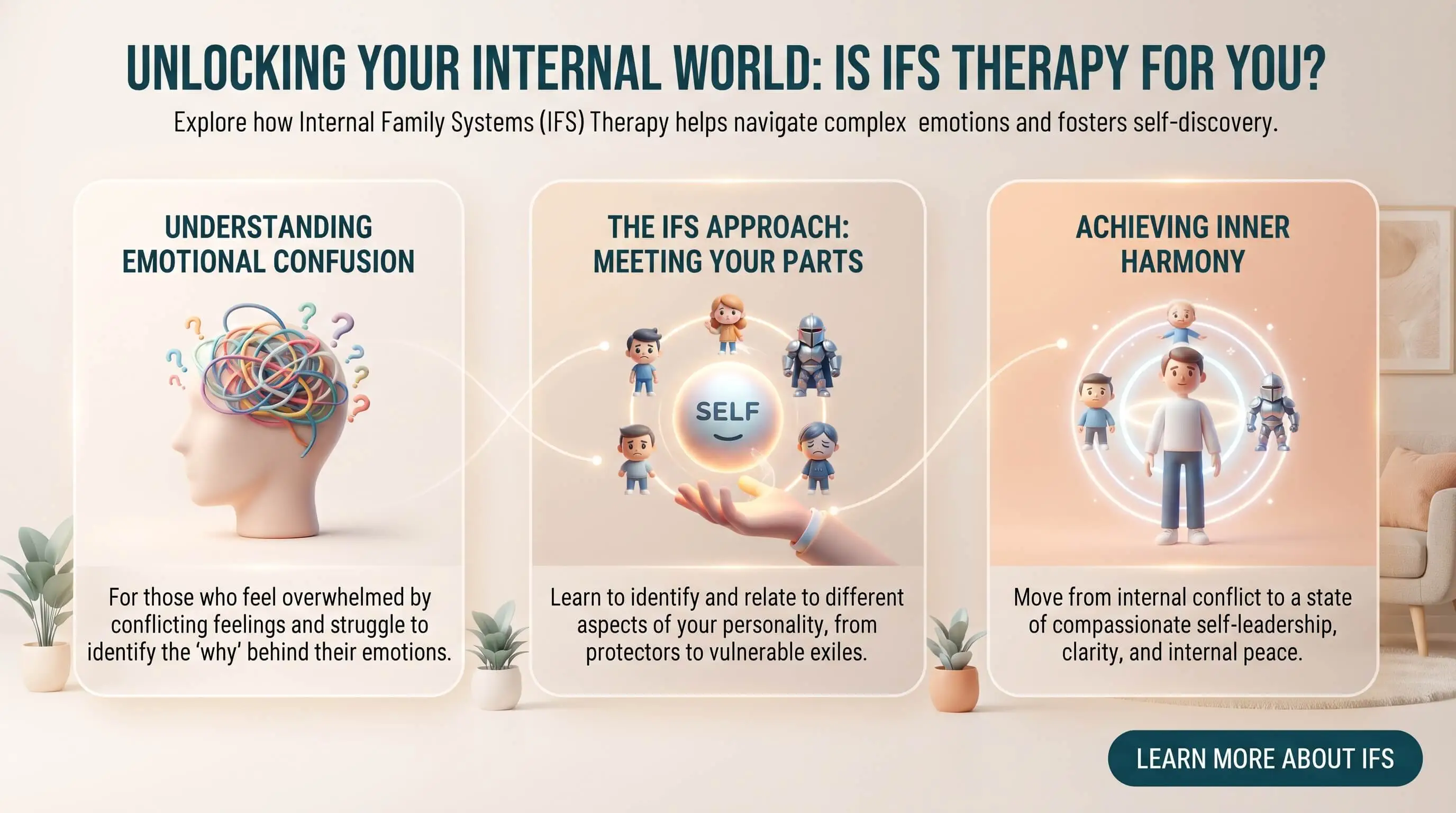
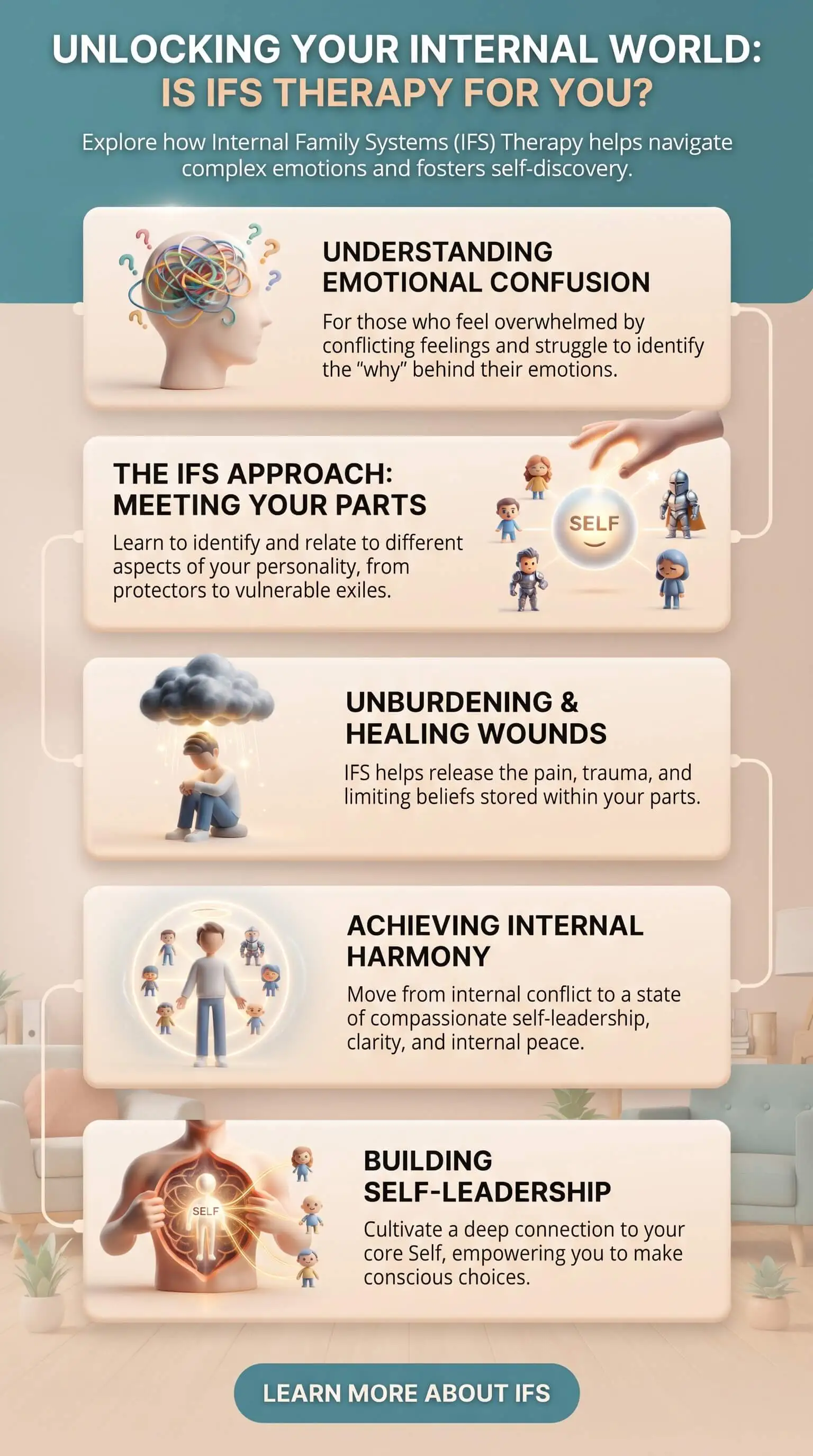
Richard Schwartz developed IFS in the 1980s. The model sees your mind as a system of parts, each trying to help in its own way, sometimes clumsily. At the center sits what IFS calls the Self, the calm and curious core everyone has, even when it feels buried.
You don't need to memorize any of the vocabulary. It's there to help you describe what's happening, and plenty of people swap in their own words.
Protectors, Exiles and the Self
IFS sorts parts into a few broad roles:
Managers keep things under control. They plan ahead, over-function, and say "I'm fine" before you've had a chance to check.
Firefighters step in when pain breaks through anyway. Scrolling, snacking, snapping at someone and shutting down are all firefighter moves.
Exiles hold older hurts that the other parts work hard to keep out of view.
From this angle, "I don't know what I feel" usually points to a protector keeping something heavy at arm's length, rather than to any failure to feel. At some point, that distance kept you safe.
Why Curiosity Works Better Than Forcing Insight
An IFS therapist won't ask you to produce the right feeling word on cue. They'll more likely ask where you notice it in your body and what it might want you to know if it could talk.
That shift matters a lot for anyone who freezes at "how does that make you feel?" You can start with nothing more than a knot in your stomach. Stay curious about it long enough and understanding tends to come out of that relationship with the part, rather than ahead of it.
Who Is IFS Therapy For?
Lauren Rath's guide on who IFS therapy is best for covers the full picture, including who it may not suit. For people who struggle to understand their emotions, IFS tends to fit when you:
Feel a lot at once. Several reactions show up together and pull in different directions.
Would rather notice and picture things than talk them through. IFS leans on sensation and imagery as much as conversation.
Live with a harsh inner critic. IFS treats the critic as a part with a reason, which often softens it faster than arguing with it ever did.
Understand your patterns but can't change them. You know why you shut down. Knowing just hasn't moved anything.
Still feel your childhood running things. You don't need major trauma for this, since old coping habits can stick around on their own.
Have done talk therapy and stalled. Many people come to IFS after years of insight that never quite changed.
Who IFS Therapy May Not Suit (Or Not Yet)
IFS asks you to turn toward difficult material, and that takes some stability. It may be the wrong starting point if:
You're in crisis or your safety is uncertain. Get immediate support first. In the U.S., you can call or text 988.
You're experiencing psychosis or severe dissociation. Specialized, stabilizing care usually comes first.
You're in active substance use that needs stabilizing. Another approach often makes a better first step, and parts work can come later.
You want worksheets, structure and homework. CBT or DBT may suit the way you learn.
IFS is also demanding work, and some weeks it leaves you tired. Waiting, or choosing a different approach, isn't a failure. Fit and timing are allowed to matter.
IFS has also grown popular online, and the Society for the Advancement of Psychotherapy has raised concerns about people using parts of language without trained support. Look for a licensed therapist with formal IFS training. You're allowed to talk with more than one before you decide.
What the Research Says
The evidence for IFS looks promising, and it's still early. The IFS Institute's research summary lists small randomized trials and single-group studies, mostly in depression and PTSD. So far, depression is the only condition that has shown statistically significant improvement across several pilot randomized trials.
Newer studies build on that base. In 2026, researchers published a randomized controlled trial of an online, group-based IFS program for PTSD, and a 2025 pilot tested a similar program with people facing both PTSD and substance use. An earlier randomized study of adults with rheumatoid arthritis (Shadick et al., 2013) [VERIFY] reported less pain, fewer depressive symptoms and more self-compassion, which counts for a lot if your inner voice runs harsh.
The field still needs larger trials. Be wary of anyone who promises you a guaranteed result.
“Most people who find their way to me already know their patterns. They can tell me exactly when they go numb, and usually why. What they can’t do is get close enough to the feeling for anything to shift. So in IFS we don’t start with ‘what’s the emotion?’ We start with ‘where do you notice it?’ A knot in your stomach is plenty to work with. And if someone’s in a crisis, I’ll say so honestly. IFS can wait until you’re steady.”
7 Essential Resources
IFS Institute: Research on Internal Family Systems. The founding organization's running list of IFS studies, with its own note that the evidence is still emerging.
Hodgdon et al.: IFS Therapy for PTSD Among Survivors of Multiple Childhood Trauma. A pilot study looking at PTSD alongside emotional dysregulation, depression and shame.
Ally et al. (2025): Online Group-Based IFS for PTSD and Substance Use. A pilot that found drops in PTSD severity and cravings, and a good look at how clinicians are adapting IFS.
Alexithymia as a Mediator Between Adverse Childhood Events and Psychopathology (Frontiers in Psychiatry, 2024). A meta-analysis tying early hardship, difficulty identifying feelings and adult mental health together.
Alexithymia and Chronic Pain: The Hisayama Study. The Japanese population study linked trouble identifying emotions with a higher risk of chronic pain.
Internal Family Systems: Exploring Its Problematic Popularity (Society for the Advancement of Psychotherapy). A balanced professional critique worth reading before you pick a therapist.
988 Suicide & Crisis Lifeline. Free, confidential support by call or text if you're in crisis or worried about your safety.
3 Statistics
23.1% of U.S. adults (59.3 million people) had a mental illness in 2022, and only 50.6% of them received treatment. Struggling emotionally is common, yet about half the people who need help still go without it. Source: National Institute of Mental Health.
About 10% of a representative German general-population sample scored above the alexithymia threshold. A Finnish population study put the figure at 13%. If naming feelings is hard for you, you have plenty of company. Sources: Franz et al., PubMed and Salminen et al., PubMed.
In a small, uncontrolled IFS pilot for PTSD, 92% of participants no longer met PTSD criteria after treatment. That's encouraging, but the sample was small and the study had no control group, so read it as a sign of promise rather than proof. Source: IFS Institute summary of Hodgdon et al..
Mental health challenges and difficulty identifying emotions are common, while early IFS therapy research shows promising but limited results. While negative pressure therapy for wound care supports physical healing, IFS therapy focuses on emotional awareness, internal experiences, and psychological well-being.
Final Thoughts and Opinion
We think IFS is one of the better-matched therapies available when the main struggle is the distance between feeling something and understanding it. You don't have to arrive knowing what's wrong. A clenched jaw or a blank feeling gives you enough to start with.
It isn't right for every season of life, though. If you're in crisis, physically worn down, or need practical coping skills this week, starting somewhere else is a sound call. And if months of wound care have left you flat, short-tempered or far away from yourself, that deserves attention too. Your care team watches the wound, and someone should be looking after the rest of you.
Frequently Asked Questions
Who is IFS therapy for?
IFS therapy often fits people who feel strong or conflicting emotions but struggle to name or change them. It also tends to suit people with a harsh inner critic and people stuck in patterns they already understand, especially when talk therapy hasn't produced lasting change.
Who may IFS therapy not suit?
IFS may be the wrong starting point for people in crisis, people experiencing psychosis or severe dissociation, or anyone in active substance use that needs stabilizing first. If you want structured skills and homework, CBT or DBT may fit better. A trained therapist can help you judge the timing.
Can IFS help if I don't know what I'm feeling?
Yes, and this is often where IFS does its best work. Rather than asking you to name the emotion first, an IFS therapist helps you notice sensations, images or reactions and stay curious about them. Over time, the feeling gets clearer through that relationship instead of through forced insight.
Is IFS therapy evidence-based?
IFS has a young but growing evidence base. Small randomized trials and pilot studies show positive results, especially for depression and PTSD, and a 2026 randomized trial tested an online group program for PTSD. The field still needs larger studies, so honest therapists call the research promising rather than settled.
How is IFS different from CBT or regular talk therapy?
CBT focuses on changing thoughts and behaviors through skills and practice. Regular talk therapy often centers on discussion and insight. IFS works with the parts behind your reactions, using curiosity, body awareness and imagery so protective patterns can relax instead of being argued with.
Can stress from a long medical recovery be worked on in IFS therapy?
Yes. An IFS therapist can help you explore the fear, grief, frustration or numbness that a long recovery stirs up. IFS won't replace medical care or speed physical healing, but it can make the emotional side of recovery feel less confusing and a lot less lonely.
Ready to Understand What Your Feelings Are Telling You?
The next step can be small. Read Lauren's full guide on who IFS therapy is best for, linked above, and notice how much of it sounds like you. Adults in Washington State can book a free 15-minute consultation with her to talk through fit, with no pressure to commit to anything. Outside Washington, look for a licensed, IFS-trained therapist near you, and take your time choosing.


